 Pardi Bali Tour
East Bali in a day: Lempuyang, Tirta Gangga and Taman Ujung
What to wear at the temples and how to plan a full day of East Bali sights.

Most first trips to Bali stay in the south and in Ubud, and that makes sense: the beaches, the cafés and the rice terraces are all within an easy drive. Head east into Karangasem, though, and the island changes pace. The roads get quieter, the villages get smaller, and Mount Agung, Bali's highest and most sacred volcano, keeps appearing between the palms, sometimes clear, sometimes wrapped in cloud.
This guide follows the route of our East Bali day: the split gate at Lempuyang Temple, the royal water palaces of Tirta Gangga and Taman Ujung, and a hilltop view of Agung at Lahangan Sweet to finish. You'll find what each stop is really like, how to pace the day so it doesn't feel rushed, and what to wear so the temple visit goes smoothly.
Why East Bali needs a whole day
The east is simply further away. From the busy south coast, the drive to Lempuyang usually takes somewhere between two and three hours each way, depending on where you're staying and how the traffic behaves. The stops are spread across Karangasem, so there's more time on the road between them than on a day around Ubud.
That's the main reason not to squeeze East Bali into a half day. Give it a full day, start early, and let someone else drive. The roads up to Lempuyang and Lahangan Sweet are steep and winding in places, and it's far nicer to look out of the window than to concentrate on hairpin bends and scooters.
The route at a glance
This is the usual order of the day. It runs from the most popular stop, which is best early, to the quietest, which suits the later hours.
- Lempuyang Temple: the famous split gate framing Mount Agung, plus the temple courtyards around it.
- Tirta Gangga: a former royal water palace of fountains, koi ponds and stepping stones.
- Taman Ujung: a wide, open water palace of white pavilions and bridges close to the sea.
- Lahangan Sweet: a hilltop viewpoint facing Mount Agung, reached by a steep road and a short climb.
The order can shift with traffic, weather and the queue at Lempuyang, and you can swap a stop if something else in the east interests you more.
Lempuyang Temple and the Gates of Heaven
Pura Lempuyang is not one temple but a whole complex of them, climbing the slopes of Mount Lempuyang. It's one of Bali's most sacred places, counted among the Sad Kahyangan Jagad, the six great sanctuaries that Balinese Hindus believe keep the island in spiritual balance. People come here to pray, and the atmosphere reflects that, even on busy days.
The gate you've seen on social media is the candi bentar, the split gateway, at Pura Penataran Agung Lempuyang, the first major temple in the complex. Stand at the top of its steps and the two halves of the gate frame Mount Agung across the valley. On a clear morning it really is as striking as the photos.
About that reflection
Here's the part that surprises a lot of visitors: there's no pool in front of the gate. The mirror-like reflection in so many photos is made by a photographer holding a small mirror just under the phone lens. It's a fun trick and the result looks lovely, but it helps to know beforehand so you're not looking for a lake that isn't there.
The photo queue, honestly
Lempuyang is popular, and the photo at the gate usually means a queue. Visitors are often given a number and called up in turn, and on busy days the wait can stretch to an hour or more. A few ways to make peace with it:
- Arrive as early as you reasonably can. Queues tend to be shorter in the morning, and the mountain is more likely to be clear.
- Take your number first, then explore. The courtyards and the views from the temple walls are worth your time while you wait.
- Decide in advance whether the photo matters to you. If it doesn't, enjoy the temple and skip the line.
Cars normally park below the temple, and a local shuttle covers the last steep stretch of road to the entrance. If you have plenty of energy and several spare hours, the path continues up roughly 1,700 steps to Pura Lempuyang Luhur at the summit, but most day visitors stay at the lower temples so the rest of the day isn't rushed.
Dress for the temple before you get out of the car. Sarongs are usually available at the entrance, but having your own, plus clothing that covers your shoulders and knees, saves time and feels more respectful.
Tirta Gangga: walking across the water
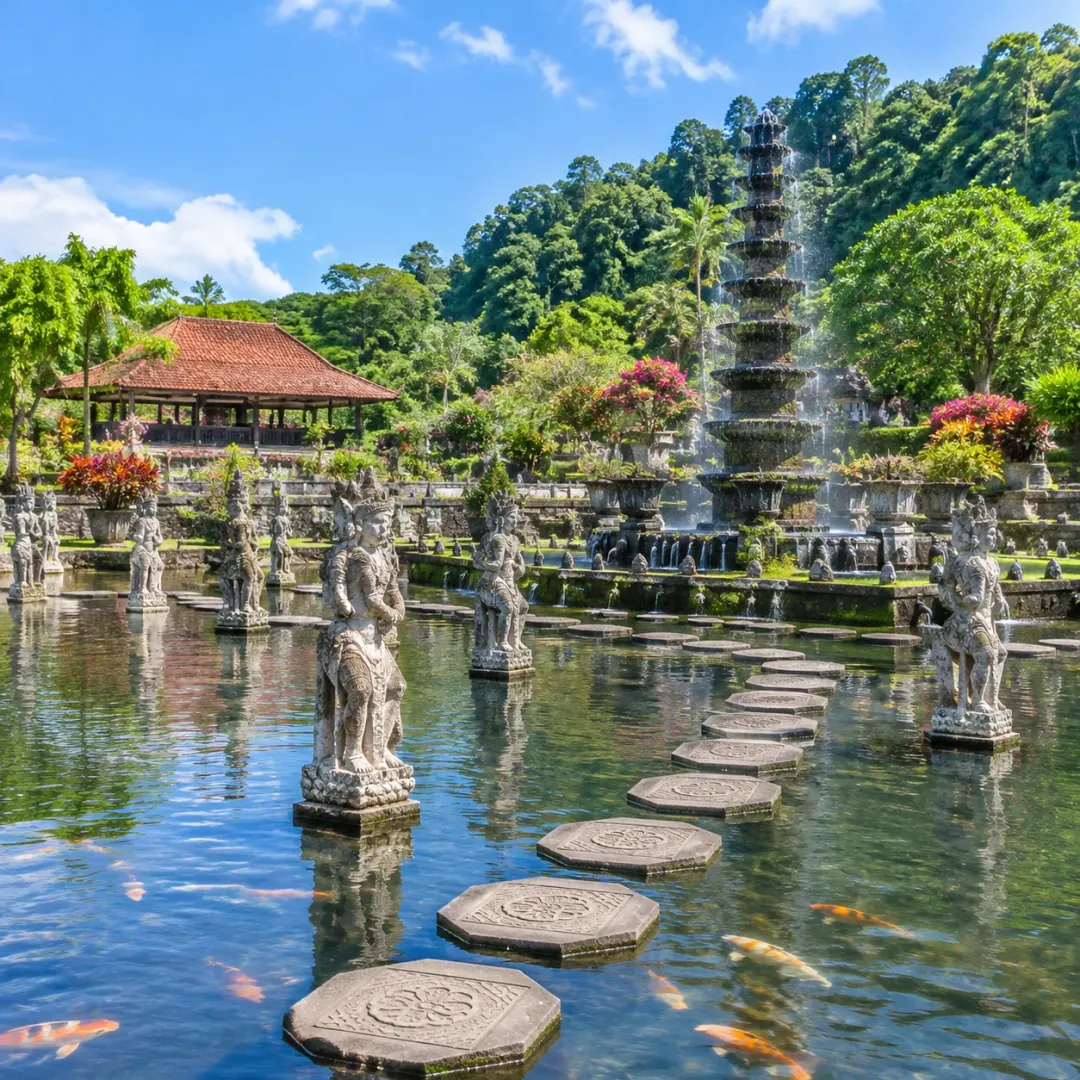
After the steps and the crowds at Lempuyang, Tirta Gangga feels like a deep breath. This former royal water palace was built in the 1940s by the last king of Karangasem, and its name refers to the sacred Ganges river in India. A natural spring feeds the pools, and its water is considered holy.
The palace is all about water. Rows of stepping stones cross the ponds, carved statues of gods and demons stand between them, and fat koi gather around your feet the moment you stop. Kids love buying a small bag of fish food, and adults usually end up doing the same. At the centre, a tall tiered fountain sends water tumbling over its levels, and the whole garden is framed by green hills and rice fields.
Give yourself around an hour here. Walk the stepping stones slowly, as some are uneven and wet, find a shady bench, and look back over the gardens from the higher terraces. It's also a natural point in the day to stop for lunch at one of the small places nearby, some with views over the rice fields.
Taman Ujung: space, sea air and fewer crowds
Taman Ujung, officially Taman Soekasada Ujung, was built by the same king and finished in the early 1920s. Where Tirta Gangga is intimate and leafy, Ujung is wide and open: white pavilions and long bridges cross large pools, with lawns, palms and green hills rising behind, and the sea just down the road.
The palace blends Balinese and European styles, a sign of its era. It was badly damaged by the 1963 eruption of Mount Agung and again by an earthquake in 1979, and what you see today is the result of careful restoration. Walk up the steps on the hillside for the best view back over the whole complex.
Because the grounds are so spacious, Taman Ujung rarely feels crowded. It's a favourite spot for pre-wedding photos, so don't be surprised to see a gown or two on the bridges. There's little shade across the open areas, so this is where your hat and water bottle earn their place.
Lahangan Sweet: ending the day up high
The last stop climbs back into the hills. Lahangan Sweet is a viewpoint facing Mount Agung, with simple platforms and photo spots built along the slope. The road up gets steep and narrow near the top, and from there it's a short climb on foot to the lookout.
When the weather plays along, the view is the reward for the whole day: the slopes of Agung in front of you, the coast stretching away to one side and villages scattered across the green below. Clouds can drift in during the afternoon, which is simply mountain weather. Sometimes they lift after a few minutes, sometimes they don't, and the shifting light is beautiful either way.
If you've had enough steps for one day, it's fine to say so. This stop is easy to shorten or swap, and you can head back towards the south a little earlier.

How to pace the day
An East Bali day works best with a clear rhythm: temple first, water palaces in the middle, views at the end. Roughly, it plays out like this:
- Early start: leave the south early so you reach Lempuyang while the queue is shorter and the mountain is more likely to be clear.
- Morning: Lempuyang Temple, with time for the gate, the courtyards and the shuttle up and down.
- Late morning: Tirta Gangga, followed by lunch nearby.
- Early afternoon: Taman Ujung, perfect for a slow walk after eating.
- Late afternoon: Lahangan Sweet, then the drive back to your hotel.
Expect to be back in the evening. Bring snacks for the car and, if you nap easily, a neck pillow for the ride home. Along the way you'll pass stalls selling salak, the scaly snake fruit Karangasem is known for. It's sweet, a little tangy and worth trying at least once.
What to wear and bring
- A sarong, or clothes that cover your knees and shoulders. This is the one thing you really need for Lempuyang Temple.
- Comfortable shoes with grip. Temple steps, wet stepping stones and the climb at Lahangan Sweet all ask for them.
- A light layer. The hills can feel cooler and breezier than the coast, especially when clouds roll in.
- Sun protection. A hat, sunglasses and sunscreen, mostly for the open grounds of Taman Ujung.
- Water and small cash. Handy for donations, sarong rental, fish food, snacks and parking.
- Patience. For the photo queue at the temple gate, and for the occasional slow stretch of road.
A few words on temple etiquette
Lempuyang is an active place of worship first and a viewpoint second. A little awareness goes a long way:
- Keep shoulders and knees covered, and wear a sarong in the temple grounds.
- Don't step on offerings, the small woven trays of flowers you'll see on steps and paths.
- Never climb on shrines or walls, and avoid standing above people who are praying.
- Give way to worshippers, and keep your voice low in the inner courtyards.
- During major ceremonies, parts of the temple may be closed to visitors. If that happens on your day, watch respectfully from a distance.
Balinese custom also asks women who are menstruating not to enter temple grounds. If that applies to you on the day, the water palaces and the viewpoint still make a lovely day on their own.
When to go
East Bali is beautiful all year, but the weather shapes the day. The drier months, roughly April to October, tend to bring clearer skies and the best chance of seeing Mount Agung through the gate. In the wetter months, mornings are often still bright, with clouds and rain more likely later in the day. Either way, mornings are your friend for mountain views.
Weekends and Indonesian public holidays bring more visitors, so the Lempuyang queue can be longer. If your dates are flexible, a weekday is usually the calmer choice.
Is this the right day trip for you?
East Bali is a good fit if you like temples, history and big landscapes, and you don't mind a longer day in the car in exchange for a calmer side of the island. It's especially rewarding if you've already seen the south and Ubud and want something different.
If you'd rather keep the driving short, a day around Ubud covers the Monkey Forest, the rice terraces and the art market closer to the main tourist areas. For cliffs, beaches and a seafood dinner at sunset, the South Bali tour is the easier choice. You can compare every option on our packages page.
Planning it with a private car and driver
Our Bali Timur Tour follows this route with a private car and driver for your group alone: Lempuyang Temple, Tirta Gangga, Taman Ujung and Lahangan Sweet. The price is per car rather than per person, starting from IDR 1,000,000, so the more of you share the ride, the less each person pays. We confirm the final price for your date and group size before the trip.
Guiding is in English or Indonesian, and a Korean-speaking guide is available on request, so just mention it when you book. If you'd like to change a stop or add somewhere else, tell us when you get in touch and we'll shape the day around it. Questions first? Send a message through our contact page or on WhatsApp.


